
Quick Facts
| Information | Details |
|---|---|
| Address | 1 AT&T Way, Arlington, TX 76011 |
| Venue type | Retractable-roof multi-purpose stadium |
| Standard capacity | 80,000 |
| Concert/expanded capacity | 100,000+ (varies by configuration) |
| Opened | 2009 |
| Primary tenant | Dallas Cowboys (NFL) |
| Website | attstadium.com |
Overview
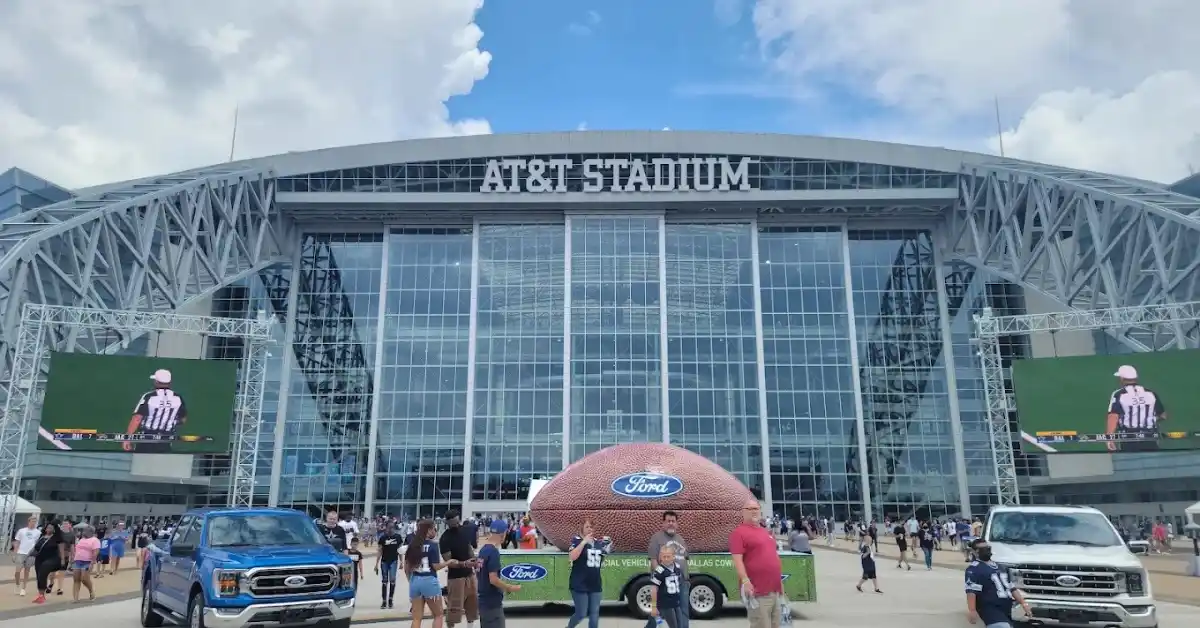
Opened in 2009 at a widely reported cost of around $1.2 billion, AT&T Stadium sits about 20 miles west of downtown Dallas and 15 miles east of downtown Fort Worth, in the Arlington Entertainment District. Two steel arches, each roughly a quarter mile long, support the retractable roof, and glass doors at each end open onto the entry plazas.
A center-hung video board hangs above the field: four screens totaling more than 25,000 square feet, with the main displays measuring 160 feet wide by 72 feet tall. It gives every seat a working sightline even when the stage itself is far away.
Because the roof and end-zone doors can close, the building runs as a climate-controlled arena for most shows rather than a true open-air stadium. That’s a real point in its favor for anyone worried about a Texas summer.
Seating and Layout
Seating runs in four main tiers around the field, plus suite and club levels layered throughout.
- Floor: General admission standing or reserved chairs set up on the turf. Closest to the stage, though sightlines depend heavily on your height and where you land relative to barricades.
- 100-Level: The lower bowl circling the field. Side sections closer to center stage tend to offer the most direct views.
- 200-Level: Padded club seating with access to air-conditioned lounges and expanded concessions.
- 300-Level: A mid-tier deck that clears most of the crowd noise and sightline obstruction found lower down, without the steep climb of the top deck.
- 400-Level: The upper deck. Steeply raked, but priced accordingly, and lined up well with the center video board.
- Suites and clubs: Field-level suites, Hall of Fame suites, and Founders Club spaces offer private seating with premium food and beverage service.
Which seats actually play best depends on the show. Touring acts most often use an end-stage setup, with the stage built into one end zone and floor seating extending out from it. Some tours instead go in-the-round, with the stage centered on the field under the video board, opening sightlines from the entire bowl. Either way, rigid flooring goes down over the turf to support staging and floor seating, and section numbers can shift slightly between events. Check your specific ticket for the exact layout rather than relying on a generic seating chart.
Capacity
The stadium seats 80,000 for football and most standard events. For major concerts, capacity can expand past 100,000 by adding standing-room floor space and, at times, additional temporary seating, though the exact ceiling depends on the show’s staging and has varied by event.
Sound and Production
The stadium’s structure was built to carry heavy touring rigs, including lighting, audio arrays, and video elements that can be suspended from the roof structure. Acoustically, results vary by location. The lower bowl and floor tend to get the clearest sound from modern line-array systems, while the upper deck can pick up some reverberation depending on the artist’s setup and whether the roof is open or closed.
Accessibility
Wheelchair-accessible platforms and companion seating are available across every tier. Accessible entrances with ramp access sit at Entries A, E, F, and K, with elevators serving all concourses. All public restrooms are accessible, and family restrooms are available on each concourse and club level. Guest Services locations offer assistive listening devices and sensory kits, and service animals are permitted throughout. As with any large venue, specific accommodations can shift by event, so it’s worth confirming current details through the stadium’s guest services line before you go.
Venue Policies
AT&T Stadium runs a strict clear-bag policy. Clear plastic, vinyl, or PVC bags up to 12″ x 6″ x 12″, plus small clutches up to 4.5″ x 6.5″, are the main allowances, along with one-gallon resealable freezer bags.
Backpacks and non-clear totes aren’t permitted, though medical and diaper bags are allowed after inspection.
The venue is fully cashless, so bring a card or mobile payment. Entry requires a mobile ticket; screenshots and printed tickets won’t work.
Outside food and drink aren’t allowed, re-entry isn’t permitted once you’ve left, and smoking is restricted to designated outdoor plaza areas.
Rules like these can change from event to event, so it’s worth checking your ticket or the stadium’s site close to showtime.
Getting There
Surface lots surround the stadium, split into zones such as Blue, Silver, and Ring of Honor, and pre-purchasing a parking pass online is the safer bet, since drive-up spots run out fast on show nights. Rideshare pickup and drop-off is concentrated around Lot 15 near Randol Mill Road, though traffic near I-30 and Highway 360 backs up significantly close to showtime. Public transit doesn’t reach the stadium directly; regional rail gets you into downtown Dallas or Fort Worth, and you’d still need a rideshare or shuttle from there.
Before You Arrive
Gates typically open two hours before showtime. Plan on arriving 90 to 120 minutes early to account for Arlington traffic, parking, and security screening. Bring your ticket loaded on your phone, a valid photo ID, a payment card, and, if you’re bringing a bag, one that fits the clear-bag size limits. The interior stays climate-controlled, but the entry plazas are exposed, so dress for the weather outside.
Frequently Asked Questions
What is the capacity of AT&T Stadium?
80,000 for standard events, expandable past 100,000 for major concerts using floor and standing-room space.
Is AT&T Stadium climate-controlled?
Yes, when the retractable roof and end-zone glass doors are closed, the interior is fully air-conditioned.
Where is AT&T Stadium located?
1 AT&T Way, Arlington, TX 76011, in the Arlington Entertainment District between Dallas and Fort Worth.
What is the bag policy at AT&T Stadium?
Clear plastic, vinyl, or PVC bags up to 12″ x 6″ x 12″, or a small clutch up to 4.5″ x 6.5″, are allowed. Backpacks and non-clear totes are not.
Is AT&T Stadium cashless?
Yes. Concessions, merchandise, and parking all run on card or mobile payment.
What are the best seats for concerts at AT&T Stadium?
It depends on the show’s staging, but 100-Level and 200-Level sections facing the stage tend to offer the strongest combination of sightline and sound, while 400-Level seats trade proximity for a clear, budget-friendly view of the center video board.
How early should I arrive for a concert?
Gates typically open two hours before showtime; plan to arrive 90 to 120 minutes early to allow for traffic, parking, and security screening.
More Venues:
- MetLife Stadium
- Madison Square Garden
- Sphere Las Vegas
- Allegiant Stadium Las Vegas
- SoFi Stadium Inglewood