
Quick information
| Information | Details |
|---|---|
| Venue | Madison Square Garden (MSG) |
| Location | 4 Pennsylvania Plaza, New York, NY 10001 |
| Venue type | Indoor multi-purpose arena |
| Concert capacity | About 20,000, depending on setup |
| Main events | Concerts, residencies, sports, comedy and special events |
| Seating | Floor, 100-level, 200-level, Chase Bridge, upper levels, suites and clubs |
| Current venue | Opened in 1968 |
| Official website | MSG.com |
Venue overview
Madison Square Garden, often called MSG or The Garden, is an indoor arena in Midtown Manhattan. The current building opened in 1968 and occupies the block between 31st and 33rd Streets and Seventh and Eighth Avenues, directly above Penn Station.
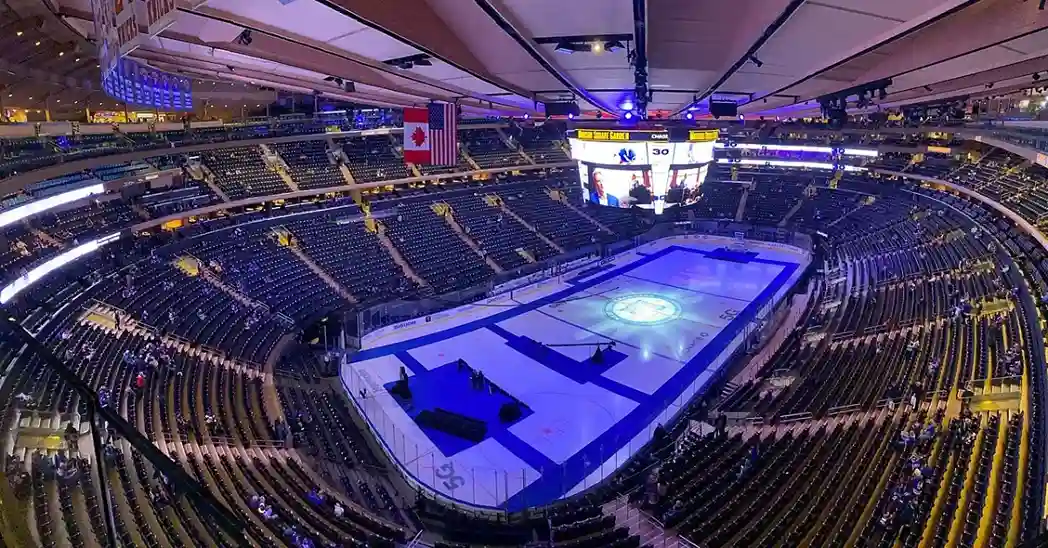
The arena is known for its circular bowl and cable-supported roof. The design avoids interior support columns, helping maintain open views toward the performance area. A major renovation completed in 2013 rebuilt seating and concourse areas and added the Chase Bridges and upgraded production and hospitality facilities.
For concertgoers, the location is one of MSG’s biggest practical advantages. Penn Station is beneath the arena, while multiple subway lines stop at 34th Street–Penn Station nearby.
Concert experience
MSG has the scale of a major arena while keeping the audience relatively close to the performance area. The enclosed bowl can create a strong crowd atmosphere during busy concerts, but the experience depends on the artist, production and seating location.
- Sightlines: The column-free interior helps keep views toward the floor open. Your actual view still depends on the section, row and stage position.
- Production: The venue’s 2013 transformation added upgraded technology and production infrastructure, including a new center-hung video display.
- Entry: Your ticket normally indicates the recommended entrance for your seat. MSG advises guests to arrive early and check event-specific instructions before traveling.
Madison Square Garden seating
MSG uses several seating areas, but the exact concert layout changes with the production.
Floor
The floor may use general admission standing areas, reserved seats, or a combination of both. Floor tickets generally put fans closest to the stage, but views in a standing area depend on your position and the people around you.
100-level
The 100-level forms the lower bowl around the floor. Sections facing the stage can provide a relatively close view, while side sections offer a more angled perspective.
200-level
The 200-level sits higher in the bowl. Centered sections can work well for fans who want a wider view of the stage, lighting, and video production.
Chase Bridge
The Chase Bridges are elevated seating and hospitality areas above the arena floor. They provide a different perspective from traditional bowl seats, with a wider view of the stage and floor.
Upper level
Upper-level seats are farther from the stage but provide an elevated view of the overall production. They can be a practical choice for fans who prioritize seeing the full stage rather than sitting close to the performer.
Suites and clubs
MSG offers multiple premium seating and hospitality areas, including suites and club spaces. Availability and access vary by event.
Best seats for concerts at MSG
There is no single best section for every Madison Square Garden concert. Stage placement, floor configuration, and production equipment can change the view.
| Preference | Seating to consider |
|---|---|
| Closest to the performer | Floor or lower-bowl seating |
| Balanced stage view | Centered lower-bowl or 200-level sections facing the stage |
| Wider production view | Elevated 200-level or Chase Bridge seating |
| More budget-friendly | Upper-level sections with a direct stage view |
| Premium experience | Suites and club seating |
Always check the seating map for the specific concert before buying tickets. MSG provides event-specific seat maps because configurations can differ.
Concert layout
Concerts at MSG can use different floor plans:
- End-stage: The stage is positioned at one end of the arena, with some sections behind or beside the stage potentially closed or limited.
- In-the-round: A central stage opens views around more of the arena.
- Reserved floor: The floor is filled with assigned seats.
- General admission: Part or all of the floor may become standing room.
The event-specific seating chart is the most reliable way to understand which sections will be available.
Madison Square Garden capacity
Madison Square Garden can accommodate about 20,000 people for concerts, although capacity changes according to the stage, floor plan and production requirements.
For sports, the practical capacity is different. MSG lists approximately 19,812 seats for Knicks basketball and 18,006 for Rangers hockey in the cited city records. Concert capacity should therefore be treated separately from the arena’s sports capacities.
Concerts and events
Madison Square Garden hosts:
- Major touring concerts
- Multi-night artist residencies
- Comedy performances
- NBA basketball
- NHL hockey
- Boxing and other combat sports
- Family and special events
The event calendar changes throughout the year, so individual concerts should be checked separately.
Accessibility
Madison Square Garden provides accessible seating, designated aisle transfer and companion seats, accessible restrooms, and assisted listening devices. The venue also provides accessibility services for guests who need additional assistance.
Accessible entrances include Chase Square on Seventh Avenue and the 8 Penn entrance at 33rd Street and Eighth Avenue. Guests needing specific accommodations should contact MSG Accessibility Services before the event.
Service animals are permitted, and guests can contact the accessibility department for assistance with seating and other accommodations.
Madison Square Garden bag policy
MSG asks guests to travel light. Bags must fit comfortably under the seat, and oversized bags larger than 22 × 14 × 9 inches are prohibited. The venue does not provide general bag or coat check services.
Policies can change for individual events, including special security requirements, so check the event page before attending.
Other venue policies
- Tickets: Guests should have their digital tickets ready on their phones before arriving.
- Cameras: Professional cameras, tripods, monopods, selfie sticks and recording equipment are generally prohibited. Some events may have additional restrictions.
- Outside food and drinks: Outside food and beverages are generally not permitted.
- Smoking: Smoking is prohibited inside the venue.
- Re-entry: Check the current event policy because venue procedures can vary.
- Payments: MSG offers cashless payment options, although cash is also accepted at designated locations.
MSG states that venue policies and event requirements can change, so visitors should check the official event information before attending.
Getting to Madison Square Garden
Public transportation is usually the easiest way to reach MSG.
- Subway: Take the 1, 2, 3, A, C or E trains to 34th Street–Penn Station. The B, D, F, M, N, Q or R trains stop at 34th Street–Herald Square, about one block away.
- LIRR, NJ Transit and Amtrak: Penn Station is directly beneath the arena.
- PATH: The 33rd Street station is within walking distance.
- Bus: M4, M10, M16, M34 and Q32 buses serve the surrounding area.
- Rideshare and taxis: Traffic around MSG can become heavy around major events.
- Parking: Nearby commercial garages are available, but MSG does not operate a dedicated public parking garage.
Best time to arrive
There is no universal door time for MSG concerts. The recommended entrance and arrival information can vary by event. For a typical concert, arriving 45 to 60 minutes before the scheduled start gives you time for security, ticket scanning, finding your section and getting concessions.
Allow more time when an event has special security procedures. MSG recommends checking your ticket and event information before arrival.
What to bring
- Smartphone with your digital ticket ready
- Valid ID when required
- Credit card, debit card or mobile payment method
- Small bag that meets the current size requirements, if needed
Check the event page before leaving because bag rules and other entry requirements can change.
Frequently asked questions
What is the capacity of Madison Square Garden for concerts?
Madison Square Garden holds about 20,000 people for concerts, with the exact capacity changing according to the stage and floor configuration.
Where is Madison Square Garden located?
MSG is at 4 Pennsylvania Plaza, New York, NY 10001, between Seventh and Eighth Avenues and 31st and 33rd Streets, directly above Penn Station.
What are the best seats for a concert at MSG?
Centered lower-bowl and 200-level seats facing the stage can provide balanced views. Floor seats are better for proximity, while elevated seats can provide a wider view of the production. The best choice depends on the specific concert layout.
Does Madison Square Garden have general admission?
Yes. Some concerts use general admission areas on the floor, while others use reserved floor seating.
What is the MSG bag policy?
Bags must fit comfortably under your seat, and bags larger than 22 × 14 × 9 inches are prohibited under the standard policy.
How do I get to MSG by public transportation?
Take the 1, 2, 3, A, C or E trains to 34th Street–Penn Station. LIRR, NJ Transit and Amtrak also serve Penn Station directly beneath the arena.
Is Madison Square Garden accessible?
Yes. MSG provides accessible seating, companion seating, accessible restrooms, elevators and assisted listening devices, along with additional accessibility services.
How early should I arrive for a concert at MSG?
Arriving 45 to 60 minutes before the scheduled start is a reasonable target for a typical concert. Check the event information for your recommended entrance and any special security instructions.