
Quick Facts
| Information | Details |
|---|---|
| Address | 525 W Santa Clara St, San Jose, CA 95113 |
| Venue type | Indoor arena and live entertainment venue |
| Hockey capacity | 17,562 |
| Concert capacity | Up to 19,000 |
| Opened | 1993 |
| Primary tenant | San Jose Sharks (NHL) |
| Website | sapcenter.com |
Overview
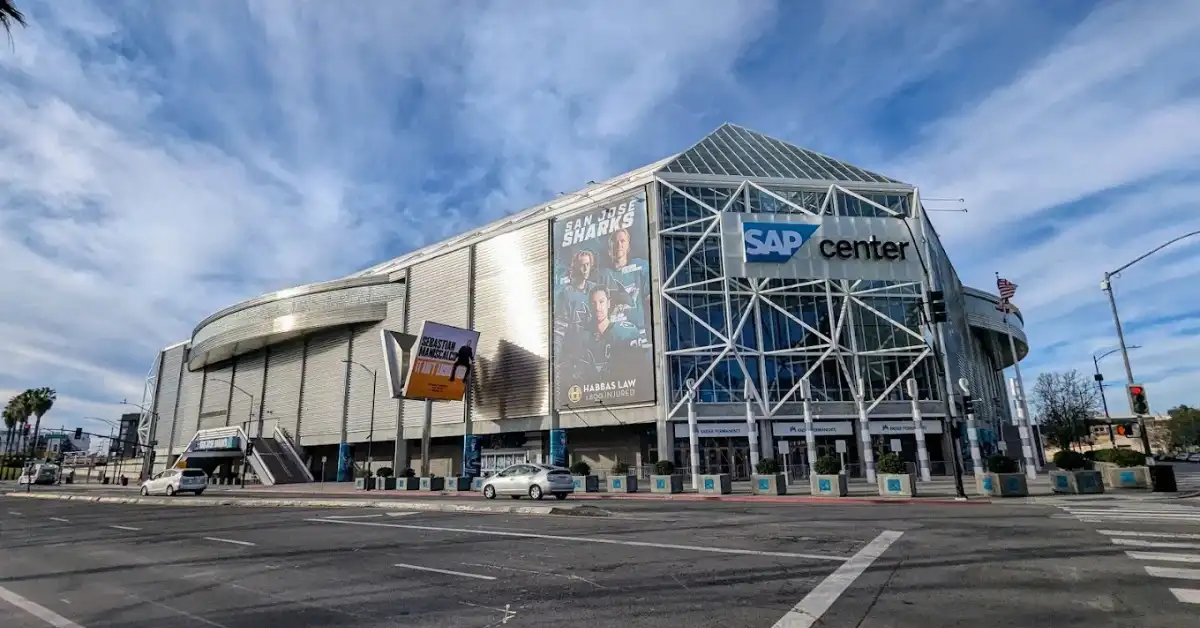
SAP Center opened in 1993 on the western edge of downtown San Jose and has been home to the Sharks ever since. Its vaulted metallic roof and broad glass facade face West Santa Clara Street, and the arena sits directly across from San Jose Diridon Station, one of the best-connected transit hubs in Northern California. Beyond Sharks hockey, the venue hosts major arena concert tours, comedy, family entertainment, and combat sports throughout the year.
Seating and Layout
- Floor (GA or reserved): The main floor, either standing general admission against the stage or assigned rows extending back toward the mix console.
- 100-Level (Lower Bowl): Encircles the main floor. Side sections, such as 101, 115, 116, and 128, offer balanced elevation and direct audio from the main speakers.
- Suite and executive levels: Between the lower and upper tiers, with climate-controlled indoor space and dedicated concession access.
- 200-Level (Upper Bowl): The upper deck. A steep row pitch keeps views clear across the full production, making the lower rows of central upper sections a solid, budget-conscious option.
Most touring concerts use an end-stage setup, placing the stage at one end of the floor and closing off the sections directly behind the backdrop. Some shows go in-the-round instead, with the stage at the center of the floor opening up the full 100 and 200 levels around it. Floor setups vary between open standing room and reserved seating depending on the performer.
Capacity
SAP Center’s official capacity is 17,562 for hockey. For full-capacity arena concerts, floor seating can expand total attendance up to around 19,000, depending on stage dimensions, production scale, and how much standing room is used.
Sound and Production
The arena’s ceiling has acoustic treatments to manage sound reflection during loud performances. The roof structure supports substantial touring rigging, letting production teams hang LED video arrays, moving light trusses, and pyrotechnic rigs over the performance space.
Accessibility
Wheelchair-accessible seating platforms with companion seats are available throughout the 100 and 200 levels. Accessible entrances include ground-level walkways, wide concourses, escalators, and elevators reaching every tier. Sensory kits with noise-reducing headphones, anti-glare glasses, and fidget tools are available free at Information Desks near the North and South entrances, and guests can re-enter with them through the Extra Assistance lane. Accessible parking is available in the primary venue lots.
Venue Policies
- Bags: Any bag up to 20″ x 14″ x 11″ is allowed, clear or not, including backpacks. Bags 5″ x 9″ x 2″ or smaller skip the X-ray line for the fastest entry; anything larger goes through X-ray screening, which adds wait time. Bags over 20″ x 14″ x 11″ aren’t permitted, and there’s no on-site bag check for oversized bags, though rentable lockers are available for a fee.
- Diaper and medical bags: Allowed regardless of size when accompanying someone who needs them, but subject to X-ray screening.
- Tickets: Digital entry only, scanned via smartphone.
- Payment: Fully cashless. Concessions, bars, and merchandise take cards or mobile payment only.
- Outside food and drink: Not permitted.
- Cameras and recording: Rules vary by event and are set by each show’s promoter, but professional cameras with detachable lenses are typically not allowed for concerts.
- Other prohibited items: Laser pointers and weapons.
Individual tours sometimes impose a stricter clear-bag-only policy on top of the arena’s standard rules, so it’s worth checking your specific event page before you go.
Getting There
- Rail and transit: San Jose Diridon Station sits directly across the street. Caltrain, VTA Light Rail, Capitol Corridor Amtrak and regional VTA buses all stop there, making transit one of the most direct ways in.
- Driving and parking: The arena is accessible via I-280, Highway 87, and US-101. On-site lots surround the arena, and additional municipal garages are within walking distance throughout downtown San Jose.
- Rideshare: Drop-off and pickup zones are set up along Montgomery Street and Autumn Street near the main entrances.
Nearby
The arena sits right next to the Diridon transit hub and connects directly to downtown San Jose. Little Italy and San Pedro Square Market are both within walking distance for pre- or post-show dining.
Before You Arrive
Plan to arrive 60 to 90 minutes before showtime to allow for parking or transit, security screening, and finding your seat before the opening act.
What to bring:
- A smartphone with your digital tickets loaded in your wallet app
- A valid photo ID and a credit card, debit card, or mobile payment method
- A small bag, ideally under 5″ x 9″ x 2″, for the fastest security line
- A light jacket for the walk after the show
Frequently Asked Questions
What is the capacity of SAP Center for concerts?
Up to around 19,000, depending on stage placement and floor layout.
Where is SAP Center located?
525 W Santa Clara Street, near downtown San Jose.
Is SAP Center a cashless venue?
Yes, all food stalls, merchandise booths, and bars accept card or mobile payment only.
What transit station is closest to SAP Center?
San Jose Diridon Station sits right across the street, with direct access via Caltrain, VTA Light Rail, and Amtrak Capitol Corridor.
What are the best seats for sound at SAP Center?
Lower-bowl sections opposite the stage, such as those around 107 to 109 or 121 to 123, tend to offer clear audio balance.
Does SAP Center have a clear bag policy?
Not by default. Bags don’t need to be clear as long as they’re 20″ x 14″ x 11″ or smaller, though smaller bags move through security faster, and some specific tours may require clear bags only.
Can you take Caltrain to concerts at SAP Center?
Yes, Caltrain stops directly at San Jose Diridon Station across the street from the main entrance.
How early should I arrive for a concert at SAP Center?
Arriving 60 to 90 minutes before showtime allows time for transit, security, and finding your section.
More Venues: