
Quick Facts
| Information | Details |
|---|---|
| Address | 1600 Ring Road, Landover, MD 20785 |
| Venue type | Outdoor multi-purpose stadium |
| Standard capacity | 64,000 |
| Concert capacity | Up to 70,000+, depending on floor configuration |
| Opened | 1997 |
| Primary tenant | Washington Commanders (NFL) |
| Website | northweststadium.com |
Overview
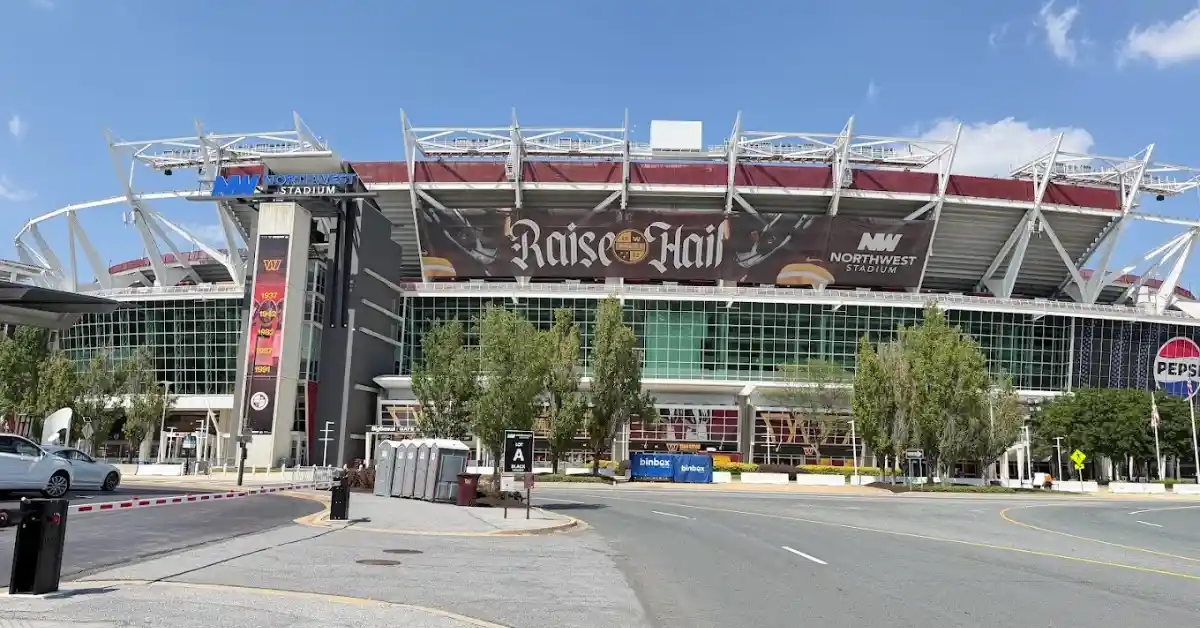
The stadium opened in 1997 as Jack Kent Cooke Stadium, was renamed FedExField in 1999, and became Northwest Stadium in 2024 following a new naming rights deal with Northwest Federal Credit Union. It sits in Landover, Maryland, roughly 10 miles east of downtown Washington, D.C. Originally built to hold more than 80,000 fans and expanded to around 91,000 in the mid-2000s, the stadium’s capacity has been reduced through a series of renovations since, landing at its current 64,000.
The venue is fully open-air, with a traditional tiered bowl surrounded by large exterior parking plazas. Beyond Commanders football, it’s the region’s main stop for summer stadium concert tours, along with international soccer friendlies and neutral-site college football games.
Seating and Layout
Seating runs across four main tiers.
- Field level: Temporary seating rows or general admission standing space installed over protective turf covering for concerts. Closest to the stage, though sightlines depend on the height of people standing ahead of you.
- 100-Level (Lower Bowl): The main fixed seating surrounding the field. Sideline sections offer a good line of sight and clear audio without relying on flat floor sightlines.
- 200-Level (Club): A mid-tier deck with wider seats, climate-controlled indoor concourses, expanded food options, and private restrooms.
- 300 and 400-Level (Upper Bowl): The highest permanent tiers, offering budget-friendly access with sweeping views of the full production. Rows here are elevated and involve long stairways, so seats near a portal elevator or concourse level help if mobility is a concern.
Most concerts use an end-stage setup, with the stage built into one end zone and the bowl sections directly behind or beside it closed off while the rest of the venue is ticketed. Rare productions instead place the stage near midfield for a 360-degree layout across the full bowl.
Depending on the artist, the floor may be an open standing pit near the stage with reserved seats behind it or fully seated front to back, so it’s worth checking the event-specific map before buying.
Capacity
Standard capacity for Commander’s games and most events is 64,000. For large concerts, capacity can expand to 70,000 or more when the grass field is repurposed for temporary seating and standing-room space, though the actual number depends on how much floor area a given show uses for staging versus seating.
Sound and Production
Sound is generally clearest on the field floor and in the lower-bowl sideline sections. Because the venue is open-air, sound can carry or thin out somewhat in high winds on the upper levels, though touring productions typically bring floor-based delay towers to help distribute audio evenly. HD video boards above the end zones supplement whatever screens a touring stage brings, giving upper-deck seats a clear view of the main camera feed.
Accessibility
Wheelchair-accessible platforms and companion seating are available across the lower bowl, club level, and upper tiers. Accessible elevator banks at the major gate entrances connect directly to the upper concourses and club areas.
Assistive listening systems and captioning are available for public announcements, and devices can be requested at Guest Services. Service animals are permitted on a leash or harness, and designated ADA parking is available in the adjacent lots for vehicles with valid state placards or plates.
Venue Policies
- Bags: Clear plastic, vinyl, or PVC bags up to 12″ x 6″ x 12″, or a small clutch up to 4.5″ x 6.5″. Non-compliant bags need to go back to your car or into an external locker.
- Tickets: Fully digital. Download your ticket to your phone’s wallet before arriving to avoid gate-side cellular congestion.
- Outside food and drink: Not allowed, except for one factory-sealed water bottle per person.
- Other prohibited items: Professional cameras with detachable lenses, umbrellas, selfie sticks, weapons, and hard-sided coolers.
- Payment: Fully cashless. Concessions, retail, and bars all take cards and mobile payment.
- Smoking: Prohibited throughout the venue, including vaping.
- Re-entry: Not permitted once your ticket has been scanned at the gate.
Because rules like these can shift by event, it’s worth checking your ticket or the venue’s site close to showtime.
Getting There
- Metro: Take the Washington Metro Blue or Silver Line to Morgan Boulevard Station. A paved pedestrian walkway leads from the station to the stadium grounds, roughly a 15- to 20-minute walk.
- Driving and parking: The stadium sits near the Capital Beltway (I-495/I-95) and Route 214 (Central Avenue). Surrounding color-coded lots require passes purchased online in advance; drive-up parking generally isn’t available.
- Rideshare: Drop-off and pickup zones are set up on the outer perimeter roads around the stadium. Expect heavy traffic on the main exit corridors after a show.
Nearby
The stadium sits in a suburban stretch of Prince George’s County, surrounded by residential neighborhoods, retail centers, and business parks rather than a downtown nightlife strip. Nearby developments along Central Avenue and Woodmore Centre offer casual dining, retail, and hotels a short drive away. Downtown Washington, D.C., is about 10 miles west, reachable by Metro or car.
Before You Arrive
Plan to arrive 90 to 120 minutes before showtime for major concerts, to allow for Beltway traffic, parking or the Metro walk, and security screening. If you’re holding general admission floor or pit tickets, arrive earlier in the afternoon to secure a spot near the stage barrier.
What to bring:
- Fully charged phone with your digital ticket loaded
- A portable power bank, since crowded stadiums drain phone batteries fast
- A clear bag that meets the venue’s size limits, if you’re bringing one
- A credit or debit card, since the venue is fully cashless
- Weather essentials: a poncho or light rain jacket (umbrellas aren’t allowed), plus a hat or sunscreen for daytime shows
Frequently Asked Questions
What is the capacity of Northwest Stadium for concerts?
Concert capacity generally runs from around 65,000 to 70,000 or more, depending on how much floor space is set aside for general admission or seating.
Where is the stadium located?
1600 Ring Road, Landover, MD 20785, roughly 10 miles east of downtown Washington, D.C.
Is FedExField now called Northwest Stadium?
Yes. Following a naming rights agreement announced in August 2024, the venue formerly known as FedExField became Northwest Stadium.
What is the best way to get to Northwest Stadium by public transit?
Take the Metro Blue or Silver Line to Morgan Boulevard Station, then follow the pedestrian pathway to the stadium gates.
What is the bag policy at the venue?
Clear plastic, vinyl, or PVC bags up to 12″ x 6″ x 12″, or a small clutch up to 4.5″ x 6.5″ are allowed.
Does the venue accept cash?
No, Northwest Stadium is fully cashless. Concessions, bars, and merchandise all take cards and mobile payment.
Are umbrellas allowed during rainy concerts?
No, umbrellas are prohibited. Bring a rain poncho or hooded jacket instead.
Where are the best seats for a concert?
Lower-bowl sideline sections near midfield offer elevated views without flat-floor sightline obstructions, while the floor pit puts you closest to the stage.
More Venues:
- Lincoln Financial Field
- Gillette Stadium
- Hard Rock Stadium
- Rose Bowl Stadium
- MetLife Stadium
- Madison Square Garden
- Sphere Las Vegas