
Key Highlights
- Downtown setting: Red Hat Amphitheater remains part of Raleigh’s convention and performing-arts district.
- Relocation: A replacement venue is being developed one block south of the original site.
- Opening plan: The operator identifies 2027 for the new venue; confirm the actual performance announcement before booking travel.
- Important distinction: Old seating maps, entrance references and parking approaches may describe the former site.
At a Glance
| Planning detail | What is established |
|---|---|
| City | Downtown Raleigh, North Carolina |
| Former venue reference | 500 South McDowell Street |
| Replacement location | One block south, within the same downtown district |
| City design requirement | At least 6,000 seats in the selected concept |
| Trip planning priority | Use the actual event’s new-site address, map and access instructions |
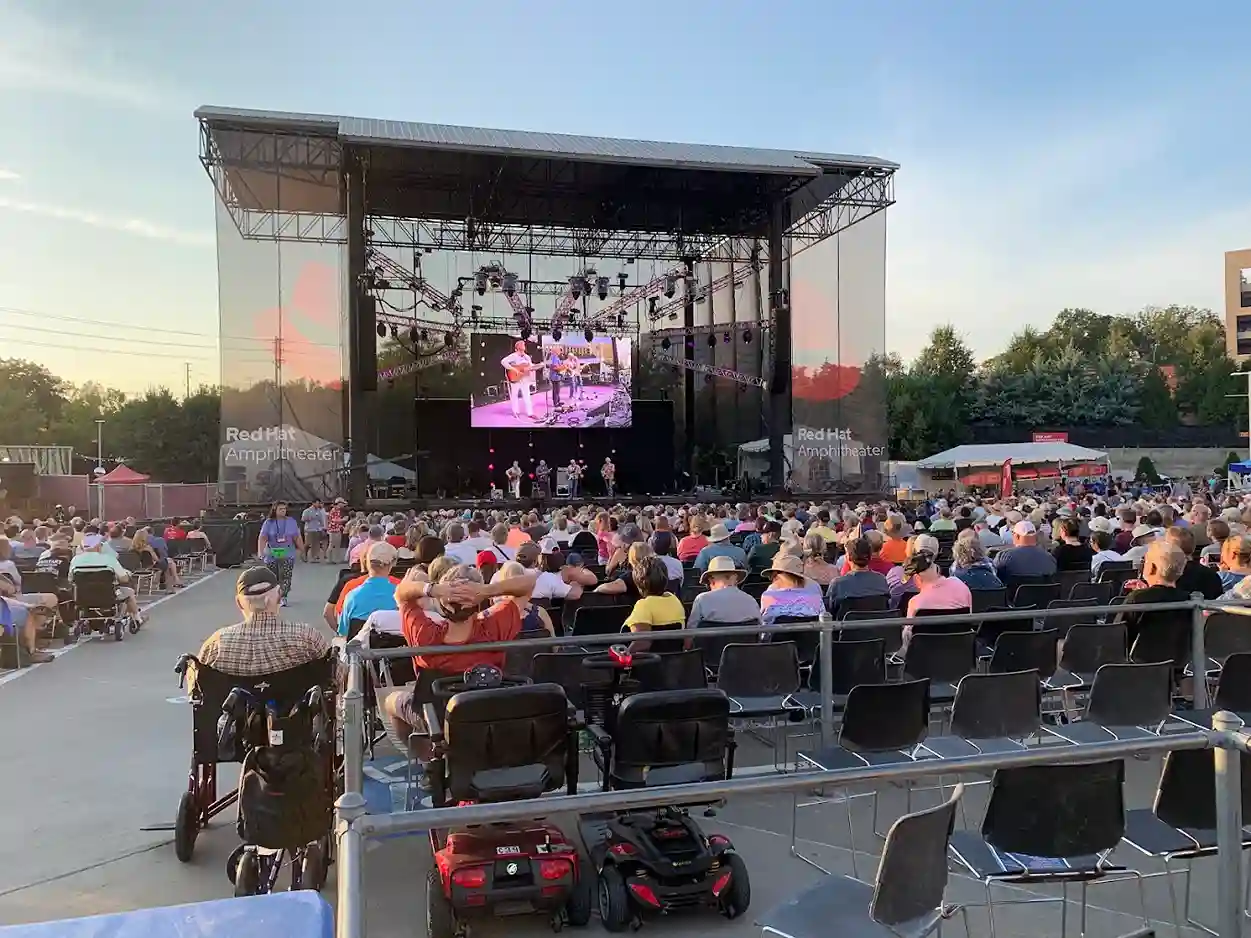
Red Hat Amphitheater is undergoing a significant change within downtown Raleigh. The City’s October 2026 update identified October 23 as the final performance at the original venue, followed by its removal from service for convention-center expansion. The replacement amphitheater is taking shape one block south, with the operator naming 2027 as the intended opening year.
That transition matters when planning a visit. The older 500 South McDowell Street address and long-established seating diagrams can still appear online. Treat them as references to the former arrangement unless the actual performance notice confirms otherwise. The new event’s admission and arrival information should control the purchase.
The Venue’s Downtown Role
Red Hat occupies an urban concert setting near the convention complex, rather than a remote amphitheater surrounded by one large parking field. Plan the downtown garage, pedestrian route and any separate dining or accommodation booking alongside the concert.
The selected relocation concept is designed to meet a requirement of at least 6,000 seats. That is a project requirement rather than a promise that every performance will sell an identical number of places. The actual concert’s production and audience map establish available inventory.
Seating Maps During the Transition
The official website has published separate diagrams with and without a pit. Those charts help explain why event format matters, but an existing diagram should not automatically be treated as the replacement venue’s final sale map. Confirm the site and performance before comparing numbered sections.
For assigned inventory, read the full section, row and seat. For a standing or general-admission offer, establish the actual area and conditions rather than interpreting a tracking number as a chair. A familiar section number does not guarantee that the same position carries over to a rebuilt venue.
Choosing Tickets and Accessible Features
Compare the new performance’s actual inventory according to proximity, angle, seated or standing format and any required accessible features. Until the appropriate map and offer are available, a precise new-site row ranking would be premature. Use the official event sale and read its disclosures.
The venue’s accessibility information describes wheelchair spaces, separately purchased companion seats and an authorized-ticketing filter for accessible inventory. Confirm how those arrangements apply to the replacement site. Old gate numbers and passenger-loading locations should not be assumed to transfer unchanged.
Parking and Construction Routes
The established visitor information lists downtown garages along Lenoir, South, Davie, Cabarrus and Salisbury streets. Those are useful district references, but the nearest available garage and walking route can change with construction. Check the event notice, garage operator and current downtown detour map before travel.
The City’s selected concept closes South Street while retaining Lenoir Street. Follow the actual signed approach rather than a remembered route through the former site. A garage reservation and a concert ticket also cover different services; verify vehicle access and exit hours independently.
Bags, Support and Final Checks
The published standard bag policy allows clear bags up to 12 by 6 by 12 inches and small clutches up to 6 by 9 inches. Recheck the chosen performance’s rules as the new venue opens. A policy retained on a general website page does not establish every new-site operating detail.
Listening and interpretation requests should be arranged with the venue ahead of time. Its published accessibility page provides advance-request procedures and sensory-support information. Confirm the actual service point and route for the chosen performance, then save the admission credential, vehicle destination and return plan together.
Frequently Asked Questions
Is Red Hat Amphitheater relocating?
Yes. The replacement is being developed one block south of the original downtown Raleigh site.
What happened to the original venue?
The City’s October 2026 update identified its final show and subsequent removal from service for convention-center expansion.
When is the replacement expected to open?
The operator identifies 2027. Confirm the actual event announcement and opening arrangements before booking travel.
Does an old seating chart establish the new venue’s layout?
No. Confirm the site and performance, then use its actual sale map and ticket conditions.
Is the project’s 6,000-seat requirement a fixed count for every concert?
No. It describes the selected concept’s requirement, while production and the performance map determine actual inventory.
Can I use remembered parking and gate directions?
Recheck them. Construction and relocation can change approaches, pedestrian routes, entrances and passenger-loading arrangements.
Official sources: Official relocation information · City closure and construction update · Seating references · Directions and parking · Accessibility · Selected relocation concept.